History of Artificial Intelligence: Modern AI
ai hriouoiurouovcdjeudoi
Artificial Intelligence (AI) has become one of the most important technologies of the modern world. Today, AI is used in smartphones, search engines, healthcare, education, business, software development, and many other fields. From voice assistants to generative AI tools, artificial intelligence is changing the way people interact with technology.
But AI did not appear overnight. The history of artificial intelligence goes back many decades and includes important discoveries in mathematics, computer science, machine learning, and neuroscience.
Understanding the evolution of AI helps us see how computers progressed from following simple instructions to learning patterns, generating content, and completing increasingly complex tasks.
What Is Artificial Intelligence?
Artificial Intelligence is a branch of computer science focused on creating systems that can perform tasks commonly associated with human intelligence.
These tasks can include:
- Learning from data
- Understanding language
- Recognizing images and speech
- Solving problems
- Finding patterns
- Making predictions
- Generating text, images, audio, and code
Modern AI includes technologies such as machine learning, neural networks, deep learning, natural language processing, computer vision, and generative AI.

Early Ideas Behind Artificial Intelligence
The idea of creating artificial beings or machines capable of performing human-like tasks is centuries old. Stories and philosophical ideas from different civilizations imagined mechanical or artificial entities with intelligent abilities.
However, the scientific foundations of AI developed much later. During the 19th and early 20th centuries, mathematicians and scientists made important advances in logic, computation, and information theory.
These developments eventually contributed to the creation of programmable computers, which provided the technology needed to investigate machine intelligence.
Alan Turing and the Foundations of AI
British mathematician and computer scientist Alan Turing played an important role in the early development of ideas about machine intelligence.
In 1950, Turing published his famous paper Computing Machinery and Intelligence. Instead of simply asking whether machines could think, he proposed a way to discuss machine intelligence through a conversational test.
This idea later became known as the Turing Test.
Turing’s work helped establish an important theoretical foundation for studying whether computers could perform tasks that appear intelligent.
The Birth of Artificial Intelligence in the 1950s
The 1950s marked a major turning point in the history of AI.
In 1956, researchers gathered at the Dartmouth Summer Research Project on Artificial Intelligence. The event is widely considered a landmark in the establishment of artificial intelligence as a formal research field.
Researchers began exploring whether computers could solve problems, reason, use language, and learn.
Early AI research was largely focused on symbolic reasoning and mathematical problem-solving.
AI Research in the 1960s and 1970s
During the 1960s and 1970s, researchers developed several early AI programs.
These systems could perform limited tasks such as:
- Solving mathematical problems
- Playing games
- Processing simple language
- Proving mathematical statements
- Performing logical reasoning
Much of this work used symbolic AI, in which knowledge was represented using rules and symbols.
Although these systems demonstrated impressive results for their time, computers had limited processing power and memory. AI researchers also discovered that real-world problems were often much more complicated than expected.
The Rise of Expert Systems
During the 1970s and 1980s, expert systems became an important area of artificial intelligence research.
Expert systems were designed to reproduce the decision-making process of specialists within specific fields. They used collections of rules and knowledge to solve particular problems.
Applications included medicine, engineering, finance, and business.
Expert systems showed that AI could provide useful solutions in specialized environments. However, they depended heavily on manually programmed knowledge and often struggled when faced with situations outside their predefined rules.
AI Winters
The development of AI was not always successful.
There were periods known as AI winters, when interest, funding, and investment in artificial intelligence declined. These periods were influenced by technical limitations, high development costs, and expectations that exceeded what available technology could achieve.
Despite these setbacks, researchers continued working on new approaches.
The lessons learned during AI winters helped shape later developments in machine learning and data-driven AI.
The Growth of Machine Learning
One of the biggest changes in the evolution of artificial intelligence came from machine learning.
Traditional computer programs generally required programmers to specify rules for solving a problem. Machine learning introduced a different approach: computers could learn patterns from data.
Instead of manually writing every possible rule, researchers could train algorithms using examples.
Machine learning became increasingly powerful as:
- Computers became faster
- Digital data became more abundant
- Storage became cheaper
- Algorithms improved
- Internet services generated enormous datasets
These developments helped move AI from rule-based systems toward data-driven learning.
Neural Networks and Deep Learning
Artificial neural networks became another major part of AI development.
Neural networks consist of interconnected computational units that can learn patterns from data. They were inspired loosely by the way biological nervous systems process information, although artificial neural networks are much simpler mathematical systems.
Later, deep learning made it possible to train neural networks with many layers.
Deep learning produced major improvements in areas such as:
- Image recognition
- Speech recognition
- Natural language processing
- Computer vision
- Recommendation systems
The combination of large datasets, powerful hardware, and improved algorithms helped deep learning become one of the most important technologies in modern AI.
Major AI Breakthroughs in the 2010s
The 2010s were a particularly important period in the history of artificial intelligence.
AI systems began achieving impressive results in image recognition, speech processing, language understanding, and strategic games.
One major milestone came in 2016 when DeepMind’s AlphaGo defeated professional Go player Lee Seldom. Go had long been considered a difficult challenge for computers because of its enormous number of possible moves.
The achievement demonstrated the potential of combining deep learning with reinforcement learning.
During the same decade, AI became increasingly common in consumer technology, including search engines, recommendation systems, smartphones, and voice assistants.
The Rise of Generative AI
The next major stage in the evolution of AI was generative artificial intelligence.
Unlike systems designed mainly to classify or predict information, generative AI can create new content.
Depending on the system, generative AI can produce:
- Text
- Images
- Audio
- Video
- Computer code
Large language models became especially important because they could process and generate human language at a large scale.
Generative AI has expanded the use of artificial intelligence into everyday activities such as writing, research, education, programming, customer support, and content creation.
AI Agents and Modern Artificial Intelligence
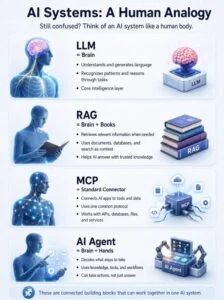
The development of AI is increasingly moving toward systems that can do more than simply answer questions.
Modern AI agents are designed to work toward objectives, plan multiple steps, use digital tools, interact with software, and complete workflows with different levels of human supervision.
This represents another stage in the evolution of artificial intelligence—from systems that mainly provide information toward systems that can assist with completing tasks.
AI History Timeline
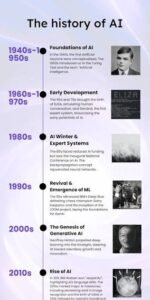
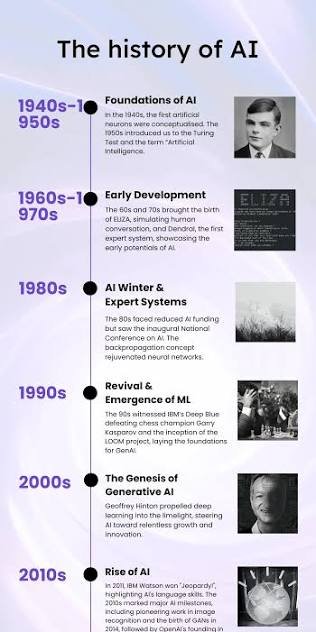
The development of artificial intelligence can be summarized through several major stages:
Before the 1950s: Early ideas about mechanical intelligence and developments in mathematics and computing.
1950: Alan Turing publishes Computing Machinery and Intelligence.
1956: The Dartmouth workshop becomes a major milestone in the establishment of AI research.
1960s–1970s: Symbolic AI and early reasoning programs develop.
1970s–1980s: Expert systems become an important AI technology.
AI winters: Funding and enthusiasm decline during periods of technical and commercial disappointment.
1990s–2000s: Machine learning becomes increasingly important.
2010s: Deep learning produces major breakthroughs in vision, speech, and language.
2016: AlphaGo defeats Lee Seldom in Go.
2020s: Generative AI and large language models become widely used.
2020s onward: AI development increasingly includes multi modal systems and AI agents capable of using tools and completing multi-step tasks.
How Artificial Intelligence Has Evolved
The history of artificial intelligence can broadly be divided into several stages:
- Early concepts of artificial and mechanical intelligence
- Mathematical and computational foundations
- Symbolic AI and rule-based systems
- Expert systems
- Machine learning
- Deep learning
- Generative AI
- AI agents and increasingly capable AI systems
Each stage built upon advances from earlier periods.
The Future of Artificial Intelligence
Artificial intelligence is continuing to develop rapidly. Future AI systems may become increasingly capable of processing different types of information, including text, images, audio, video, and structured data.
AI is also expected to remain important in areas such as education, healthcare, manufacturing, transportation, cybersecurity, scientific research, and software development.
However, the continued development of AI also raises important questions about privacy, security, misinformation, copyright, employment, transparency, and responsible development.
These issues will be an important part of the future discussion surrounding artificial intelligence.
Conclusion
The history of artificial intelligence is a story of scientific research, technological progress, setbacks, and major breakthroughs.
From early ideas about machine intelligence and Alan Turing’s foundational work to symbolic AI, expert systems, machine learning, deep learning, generative AI, and modern AI agents, artificial intelligence has undergone a remarkable transformation.
AI has moved from research laboratories into everyday technology and is now an important part of the digital world. Understanding the evolution of AI provides useful context for understanding both the technology we use today and the developments that may shape its future.
Frequently Asked Questions (FAQs)
1. What is the history of artificial intelligence?
The history of artificial intelligence refers to the development of ideas, technologies, and research that have enabled computers to perform tasks associated with human intelligence. Modern AI developed through several stages, including symbolic AI, expert systems, machine learning, deep learning, and generative AI.
2. Who is known as the father of artificial intelligence?
John McCarthy is often associated with the founding of AI as a formal research field. He coined the term “artificial intelligence” and helped organize the 1956 Dartmouth workshop.
3. When did artificial intelligence begin?
Artificial intelligence became a formal academic research field in the 1950s. The 1956 Dartmouth Summer Research Project on Artificial Intelligence is widely regarded as a major milestone in the beginning of modern AI research.
4. What did Alan Turing contribute to AI?
Alan Turing made important contributions to the theoretical foundations of computer science and machine intelligence. In 1950, he published Computing Machinery and Intelligence and proposed what became known as the Turing Test.
5. What are the major stages in the evolution of AI?
Major stages include early computing research, symbolic AI, expert systems, machine learning, neural networks, deep learning, generative AI, and modern AI agents.
6. What is machine learning?
Machine learning is a branch of AI in which computer systems learn patterns from data and use those patterns to make predictions or perform tasks without requiring every rule to be manually programmed.
7. What is deep learning?
Deep learning is a type of machine learning that uses neural networks with multiple layers. It has played an important role in advances in computer vision, speech recognition, and natural language processing.
8. What are AI winters?
AI winters are periods when interest, funding, and investment in artificial intelligence declined because of technical challenges, high costs, or expectations that were not met.
9. What is generative AI?
Generative AI refers to AI systems that can create new content such as text, images, audio, video, or computer code based on patterns learned from data.
10. What is the future of artificial intelligence?
The future of AI may include increasingly capable systems that can understand multiple types of information, use digital tools, and complete more complex tasks. At the same time, issues such as privacy, security, copyright, employment, and responsible AI development will remain important.
History of Artificial Intelligence History of AI Artificial Intelligence AI History Evolution of AI Evolution of Artificial Intelligence AI Timeline History of Machine Learning Machine Learning Deep Learning Generative AI AI Agents Alan Turing AI Dartmouth AI Conferen