AI Security: Protecting Intelligent Systems
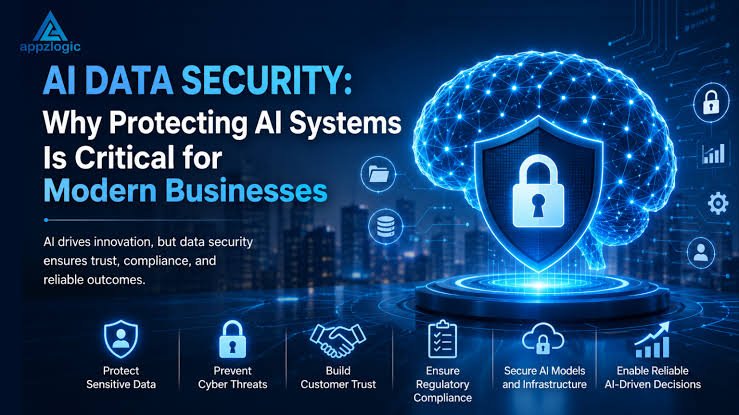
AI Security: Protecting Intelligent Systems from Cyber Threats
What Is AI Security?
AI Security Traditional cybersecurity focuses on protecting data, networks, and software. AI security expands that scope. It must defend not only the models and the data they learn from, but also the integrity of their decision-making process. An attacker who compromises an AI system can:
- Poison training data so the model learns harmful or biased behaviors
- Extract sensitive information through model inversion or membership inference attacks
- Manipulate inputs (adversarial examples) to force incorrect outputs
- Steal proprietary models through model extraction
- Disrupt or take control of AI-driven physical systems
Because AI systems increasingly operate in high-stakes environments—healthcare, finance, critical infrastructure, and autonomous weapons—the consequences of failure can be severe.
Importance of AI Security:
1. Data Poisoning
Attackers inject carefully crafted malicious samples into training datasets. Even a small percentage of poisoned data can cause a model to misclassify specific inputs or behave unpredictably in targeted scenarios.
2. Adversarial Attacks
Subtle, often imperceptible changes to input data can cause state-of-the-art models to fail dramatically. A stop sign with a few strategically placed stickers, for example, might be interpreted by a self-driving car as a speed-limit sign.
3. Model Extraction and Intellectual Property Theft
Through repeated queries, adversaries can approximate a proprietary model’s behavior and recreate it. This undermines commercial advantages and can enable further attacks.
4. Privacy Leakage
Models can unintentionally memorize and later reveal sensitive training data. Membership inference and model inversion attacks exploit this vulnerability.
5. Supply-Chain and Infrastructure Risks
AI systems depend on complex software stacks, third-party libraries, cloud platforms, and hardware accelerators. Compromises at any layer can cascade into the model itself.
AI Security Data Security in AI
Effective AI security requires a multi-layered approach that combines technical defenses, organizational practices, and emerging standards.
Technical Defenses
- Adversarial training and robust optimization techniques
- Differential privacy and secure multi-party computation for protecting training data
- Model watermarking and fingerprinting to detect theft
- Runtime monitoring and anomaly detection for unusual model behavior
- Formal verification methods for high-assurance systems
- Secure model serving architectures that limit query access and rate-limit attacks
Organizational and Process Measures
- Rigorous data governance and provenance tracking
- Red-team exercises specifically designed for AI systems
- Continuous evaluation of model robustness across the lifecycle
- Clear accountability for AI risk ownership
- Incident response plans tailored to AI-specific failures
Standards and Collaboration Bodies such as NIST, ISO, and industry consortia are developing AI risk management frameworks. Organizations should align with these evolving guidelines while contributing to shared threat intelligence.
AI SecurityLooking Ahead
As AI systems become more autonomous and increasingly integrated into critical infrastructure, the attack surface will continue to expand. AI Security will face emerging challenges such as securing foundation models, defending against AI-powered attacks that generate sophisticated adversarial examples, and protecting AI agents that interact with external tools, APIs, and digital environments.
The goal of AI Security is not perfect security—an unrealistic target—but resilience. Secure AI systems should be able to detect potential compromises, limit damage, recover quickly, and continuously improve their defenses. Achieving this will require treating AI Security as a first-class engineering discipline rather than an afterthought.
Protecting artificial intelligence is ultimately about protecting the decisions and actions that AI enables. In the digital age, effective AI Security will be essential for ensuring that intelligent systems can deliver their capabilities reliably, responsibly, and safely.


#AISecurity #ArtificialIntelligence #CyberSecurity #AIProtection #MachineLearning #DataSecurity #AdversarialAttacks #SecureAI #AIThreats #DigitalSecurity #AISafety #TechSecurity #IntelligentSystems #CyberThreats #AIRisks